
The Great Real Estate Takeover: What the Megamergers and Portal Wars Mean for You
By Tracey Barrett
June 2026
If you’ve tried to buy or sell a home recently, you already know the housing market is facing unprecedented headwinds. Driven by three-decade lows in sales volume and persistent affordability issues, the real estate industry is undergoing a massive, historic restructuring. (Source 1)
Behind the scenes, a flurry of blockbuster corporate mergers is erasing the traditional landscape of neighborhood brokerages, replacing them with a few tech-powered “megabrokerages.” Concurrently, a fierce legal battle is erupting over who controls home listing data. (Source 2, Source 3)
Here is a plain-English guide to the major real estate takeovers, the explosive battles between tech portals and brokerages, and what it all means for the average consumer.
Part 1: The Massive Wave of Real Estate Consolidation
To survive a sluggish market, major real estate firms are joining forces to achieve economies of scale—combining operations to cut corporate overhead and maximize revenue per transaction. (Source 4) Four massive deals have completely reshaped the industry ecosystem:
1. Compass Acquisition of Anywhere Real Estate
In a historic $1.6 billion megamerger, Compass (the largest U.S. brokerage by sales volume) acquired Anywhere Real Estate. Anywhere’s portfolio features legacy, household brands including Coldwell Banker, Century 21, Sotheby’s International Realty, Corcoran, ERA, and Better Homes and Gardens Real Estate. By absorbing Anywhere, Compass integrated these brands onto its proprietary technology platform, creating an industry behemoth commanding a global network of roughly 340,000 agents. (Source 5)
2. The Real Brokerage Acquires RE/MAX
In an $880 million enterprise transaction, the fast-growing, cloud-based firm The Real Brokerage acquired RE/MAX Holdings. This strategic pairing matches RE/MAX’s extensive global brick-and-mortar franchise footprint with Real’s cutting-edge, AI-driven digital platform. Crucially, this deal grants Real control over Motto Mortgage, a national mortgage franchise network, allowing the combined entity to vertically integrate real estate brokerage and home lending services. (Source 6, Source 7, Source 8)
3. eXp World Holdings Absorbs NextHome
Virtual brokerage pioneer eXp Realty expanded its market share by absorbing NextHome, a massive franchise network encompassing over 500 offices. This acquisition enables eXp to operate a multi-brand ecosystem, allowing real estate agents to choose between eXp’s borderless, virtual model or NextHome’s community-centric franchise structure. Following the acquisition, the parent company filed to transition its Nasdaq ticker from EXPI to AGNT. (Source 9, Source 10)
4. Zillow and Realtor.com Strategic Partnership
In an unexpected industry shift, the two leading consumer real estate portals—Zillow and Realtor.com—joined forces. Rather than an outright corporate merger, they launched a data-sharing partnership. By linking their platforms, “Preview” (pre-market) home listings syndicated to either site instantly appear on both, ensuring home buyers utilize synchronized property inventory across both applications. (Source 11, Source 12)
Part 2: The Portal Wars — Zillow vs. Compass & MRED
While major real estate brokerages consolidate, they are simultaneously locked in an aggressive turf war with consumer tech portals over lead generation and data ownership. (Source 13)
The battle centers on “Private Listing Networks” (PLNs). Historically, when an agent lists a home, the data is uploaded to a local Multiple Listing Service (MLS) so all licensed participants and public search engines can access it. However, brokerages have increasingly utilized private networks to market homes quietly before they hit the public market. (Source 14)
This tension culminated in a federal antitrust lawsuit filed by Zillow against Compass and Midwest Real Estate Data (MRED)—the prominent MLS serving the Chicagoland area. (Source 15)
-
Zillow’s Antitrust Allegations: Zillow claims that Compass and MRED conspired to withhold home listings from the public by confining them to a private network. The lawsuit alleges that MRED and Compass violated the Sherman Antitrust Act by threatening to cut off Chicago’s property data feeds unless Zillow agreed to display these hidden listings on the defendants’ terms, restricting open market competition. (Source 16, Source 17)
-
The Brokerage and MLS Defense: The defendants argue that private or “preview” networks protect consumer choice. They contend that home sellers frequently request off-market or pocket listings to test pricing strategies quietly or limit foot traffic for privacy and security reasons.
Part 3: Compare & Contrast: How Compass’s Actions Impact Zillow
The aggressive expansion of Compass directly threatens Zillow’s core business model. Both companies are competing for ultimate control of the real estate transaction funnel.
Disruption of the Lead Generation Ad Model
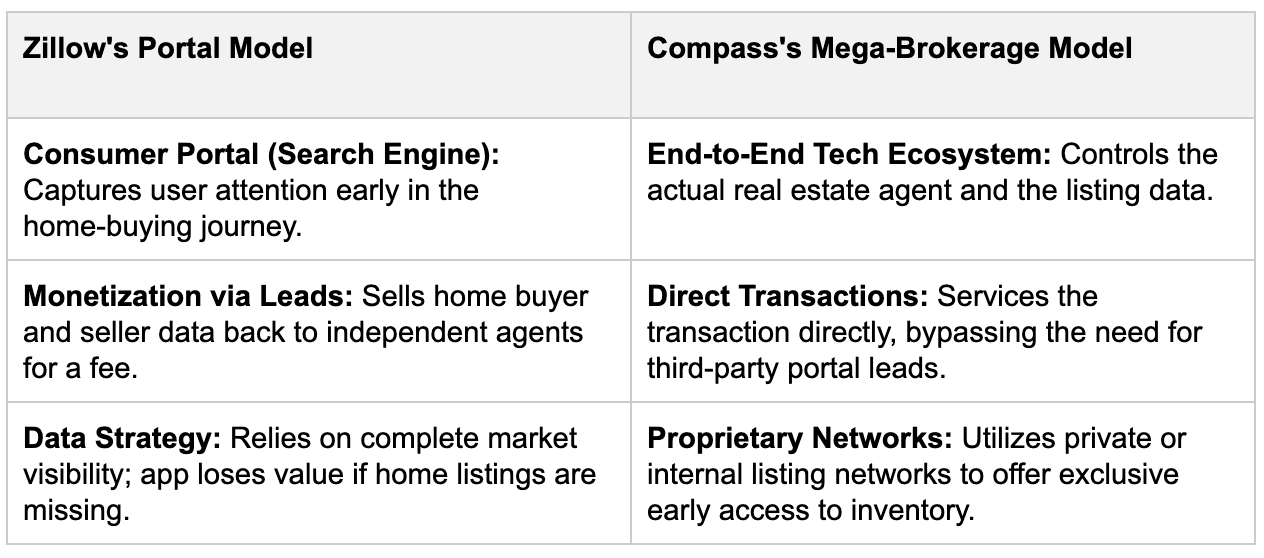
Zillow generates a significant portion of its revenue by capturing home buyer attention and selling those user “leads” to real estate agents through programs like Premier Agent. Compass’s end-to-end technology platform circumvents this. By controlling legacy brands like Century 21 and Coldwell Banker, Compass keeps buyers, sellers, and transactions within its own ecosystem. Agents utilizing Compass’s internal network have less reliance on buying third-party leads from Zillow. (Source 18)
Proprietary Data Networks vs. Open Market Visibility
Zillow’s platform value relies on comprehensive data aggregation; the search portal loses utility if home listings are missing. By establishing exclusive private listing networks, Compass attempts to ensure that premium, early-stage inventory can only be accessed through a Compass agent. Zillow’s recent partnership with Realtor.com to share “Preview” listings serves as a direct defensive counter-move to maintain data supremacy against brokerage isolation.
Part 4: Pros and Cons for the Real Estate Consumer
While industry executives assert that market consolidation streamlines the home buying process, consumer advocacy groups warn of reduced transparency.
The Benefits (The Pro-Consolidation Argument)
-
Streamlined Vertical Integration: Buying a home traditionally requires coordinating with separate brokerages, mortgage lenders, title companies, and escrow offices. Megabrokerages are resolving this fragmentation by bundling AI-driven transaction tech, real estate agents, and in-house lending networks (like Motto Mortgage) under one roof to deliver a “one-stop-shop” experience. (Source 19)
-
Advanced Technology for Local Agents: Independent neighborhood brokerages often lack the capital to develop advanced AI matching tools or predictive marketing software. Corporate consolidation provides local agents with world-class technology, enhancing property marketing and localized search efficiency.
The Detriments (The Anti-Consolidation Argument)
-
Reduced Market Competition: When a handful of conglomerates dominate market share, consumers lose bargaining power. Diminished local competition makes it increasingly difficult for home sellers to negotiate lower commission rates or transaction fees.
-
Asymmetric Information and “Hidden Markets”: The proliferation of private listing networks means public portal users may look at Zillow or Realtor.com and receive an incomplete picture of available housing inventory. If premium properties are restricted to internal brokerage networks, buyers are structurally forced to hire specific corporate agents simply to view available homes.
Summary: The Future of Real Estate Search
The housing market is evolving into a battle between Megabrokerages (Compass, Real, eXp), who aim to control the real estate agent network and monetize the transaction directly, and Portals (Zillow, Realtor.com), who fight to keep market data public to preserve their status as digital gatekeepers. For consumers, navigating this shifting environment requires awareness that the property search tools they rely on may no longer display the entire market. (Source 20)
The expansion of private listing networks means the average buyer might look at Zillow or Realtor.com and think they are seeing every home for sale—when in reality, some of the best homes are being traded privately within a megabrokerage’s internal network. This forces buyers to hire specific corporate agents just to get a look at available homes, destroying market transparency.
The Bottom Line
The real estate market is turning into a battle of the titans. On one side are the Megabrokerages (Compass, Real, eXp), who want to own the agents and keep real estate transactions within their corporate ecosystems. On the other side are the Portals (Zillow, Realtor.com), who want to keep the market completely open and public so they remain the gatekeepers of housing data.
For the average reader, this means the tools you use to find a home are shifting. While you may enjoy sleeker apps and more streamlined financing options in the future, you will need to keep a sharp eye out to ensure you are seeing the whole market—and not just what a corporate giant wants you to see.
Want to Learn More? Substantiated Industry Sources
Documented Industry Sources
-
Compass / Anywhere Real Estate Merger: Definitive all-stock merger agreement valued at approximately $1.6 billion, consolidating Compass with Coldwell Banker, Century 21, and Sotheby’s International Realty. Source: Compass Investor Relations / Realtor.com Industry Reports (January 2026).
-
The Real Brokerage / RE/MAX Acquisition: Corporate enterprise-value transaction totaling $880 million, merging Real’s digital platform with RE/MAX’s global franchise network and Motto Mortgage under the Real REMAX Group. Source: Florida Realtors / South Florida Agent Magazine Financial Briefings (April 2026).
-
eXp World Holdings / NextHome Deal: Corporate acquisition adding NextHome’s 500+ franchise locations into the eXp multi-model ecosystem, accompanied by a Nasdaq ticker transition to AGNT. Source: SEC Form 8-K Filing / Real Estate News Corporate Disclosures (May 2026).
-
Zillow v. Compass & MRED Antitrust Lawsuit: On May 12, 2026, Zillow filed a federal antitrust lawsuit in Chicago against Midwest Real Estate Data (MRED) and Compass. The suit alleges a violation of the Sherman Antitrust Act, claiming the defendants colluded to hide properties within private listing networks and threatened to revoke Zillow’s access to Chicagoland data feeds if Zillow didn’t comply with displaying hidden listings on their terms. Source: Federal District Court Civil Docket / Industry Legal Updates (May 12, 2026).